Saturday, January 30, 2016

On Re-Takes and Second Chances

There has been a slow shift in thinking around the schoolhouse lately.  Emphasis on the word slow.  Or at least this is what I had thought.  At least in my own building, which is a 6-8 middle school building, where we are working on a number of things, including making sure that people understand the middle school philosophy and the central tenets that should be found in every middle school building; grading and reporting practices that are fair and meaningful to every student; and how we can incorporate student voice into the school day.

What I want to focus on here is the belief by many that learning will occur for all, and that we will do whatever it takes to ensure this supreme goal.

Except when time gets in the way and learning has to, for some reason, end.

This week, I sat in a room with some exceptional educators from around the district's 3 middle schools.  The topic was allowing students to re-take assignments and even assessments in order to ensure mastery. Some of the dissenting viewpoints focused on why it wasn't working, the opinion that students were not learning but instead, just trying to earn a better grade (emphasis on the letter grade and not the learning itself), and the worry that we really aren't teaching "quality life lessons" by offering second chances.

Okay, just to clarify a few things.  This is our first year dabbling with a mandatory re-take policy across all middle schools.  This is also our first year attempting to establish some consistent language and understandings across departments and grade levels.  These are good things.  Good things for both students and the teachers who instruct them.

But these aren't first year teachers.  These are educators who, for the most part, have many, many years of experience across the collective whole.

Why, then, are we wondering if offering 2nd chances is really teaching kids "quality life lessons?"  Why, when someone mentions that offering re-takes is really not encouraging mastery of learning, isn't someone speaking up and screaming, as loud as they can, "AND WHOSE FAULT IS THIS?"

Because I have a feeling I know the answer to this one.  I have a strong suspicion that the answer here, would be the ever-familiar, "Well, it's the student's fault, of course; it's the student's fault they didn't learn it the first time... they've learned how to work the system, and understand that this is a matter of not having to try hard the first time because I know I will get a second chance."

And so I reiterate what I said before, and I also wonder about it and am scared by it:  We believe that learning by all is the supreme goal, and that everyone is capable of learning.  Scan through school and district websites and I guarantee you will see a variation of this statement on just about every one.

But do we believe it? 

I mean, do you know of any educators who, when asked this to their face, would say no to this claim?  I don't either.  Until time gets in the way and the class period is disrupted by that horrendous bell, or the end of the unit is here and we have to give that dreaded summative assessment.  At this point, learning has to come to an end because, of course, if they didn't learn by now then we have to move on.  Every one of them, lock-step in line with one another, all learning at the same pace and all learning the same thing... and all knowing that the learning must come to an end because we, the adults, the professionals, the ones who know best, who have done the research (hopefully), and who have spent billions of collective dollars on advanced degrees, have created this environment where learning is the one variable and time is the one fixed thing, and we know it should be the other way around.


Sunday, September 6, 2015

Being the Best

Sunday morning.  Our second oldest is headed back to the airport after having spent the last four days with us.  I dive under my headphones to get something written, knowing that I will have limited time.  The little kids are all jammed in front of Alvin and the Chipmunks and the baby is asleep.  I am through with feeling guilty about putting the kids in front of the tube to get a little time to myself.  Selfish, one might think, and I used to agree, but I no longer care.  Not with 4 foster children all under the age of six, 4 biological children ages 14-28, three dogs - one of which is the size of a small horse - a very demanding career, and a loving marriage of almost 23 years that, regardless of what people might think after 23 years, does not run itself.  These things require time and care and energy and, most of all, love. 

And in order to have all that, you have to be willing to commit.  And make sacrifices.  
What I know at this age (44), and after this much time in public education - 19 years - is that sacrifice is a human endeavor that appears at first as loss.  In order to sacrifice something, really make a sacrifice, you must feel the loss; you must acknowledge that there is something missing from your daily routine.  For example, if you really care about being the best baseball player on the planet, you have to be willing to sacrifice certain things like Twinkies and double chocolate Oreo shakes.  You also have to be willing to add things into your daily routine, like cardio workouts and batting practice and taking 200 ground balls three times a day.  In order to make room for these things, to which you have committed in order to be the best on the planet, other things have to go.  

For me, the things that have had to go are plentiful.  I am not trying to be the best baseball player on the planet (although that would have been cool), but I am trying to be the best father, the best husband, the best foster daddy, the best middle school principal and role model for my school kiddos, the best leader for my teachers, and the best doctoral candidate on the planet.  These endeavors, I am convinced, are more difficult than trying to be the best baseball player on the planet.  The sacrifices made have come in the form of dancing in the kitchen when I know I should be working at my computer, being the consistent disciplinarian when I would much rather be having fun and laughing mistakes away, and letting go of the people in my life who can't - or won't - contribute goodness and usually only add problems and grief to my already overflowing plate. 

This is how I strive to become the best.  These are the sacrifices that, at one point in my life, would have caused me to say yes when I knew I should be saying no.  These are the things I have been wiling to give up - and some I've added - in order to be the best.  I don't have time for anything else in my quest.  Neither do you.  It starts with taking stock of everything going on in your life - all of the things and people to whom you are responsible - and asking yourself what the vision is.  Once the vision is established, it is time to make some commitments.  You will soon see what needs to be cut from, and added to, your daily routine.  Make the sacrifice to become the best whatever-it-is-you-want-to-be.   


Sunday, January 25, 2015

Improving from Within

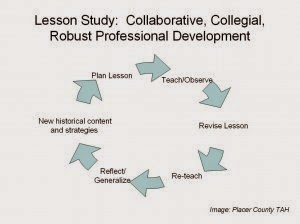
Lesson Study Cycle
I spent the past week working with a motivated team of educators to understand how to help groups of 8th graders move from concrete to more abstract thinking.  It has shown me, once again, the power that a small group of people can have when they set their minds to it.

Japanese Lesson Study as a form of teacher professional development has the potential to change how educators view teaching and lesson planning, how they view what students take away from a given lesson, how students view a block of instructional time in the classroom - whether they are just enduring, or whether they are truly engaged and learning.  A few conditions have to be met and understood first, however, if Lesson Study is to truly make a difference and take hold in any school setting.  This post is not about what Japanese Lesson Study is, or how it works; you can certainly find much on the concept by doing a simple online search.  Rather, my purpose here is to document my thoughts on this intense form of professional development.

After spending the week planning, observing, debriefing, and reteaching with this team, it became clear to me that everyone really needed a break.  We ended the cycle on Friday, still needing to debrief the re-taught lesson, but agreed that it would just have to wait until Monday.  It had been an exhausting week.  Mentally taxing.  But some of the best PD we had ever been through.  

To be clear, this process is not a quick fix; better teaching and deeper understanding do not happen overnight.  Lesson Study is a process, the results of which can be powerful and lead to a thorough understanding of concepts over time.  For example, we were wondering why our 8th grade students have such a hard time thinking in abstract terms.  Is it developmental?  Are they even capable of thinking in the abstract, knowing what we know about natural learner characteristics of the adolescent student?  Through the intense process of Lesson Study - as the team developed the lesson, observed one of the teachers on the team deliver the lesson, debriefed, made changes, and then re-taught the lesson - we discovered that, through careful and deliberate questions, well-placed times for the teens to turn and talk to one another, the intentional use of visuals to aid in thinking, and plenty of built-in time for reflective thinking and writing, our teens are indeed capable of beginning to understand thinking in abstract terms.

In further posts on this topic, I will explore the topic of "soft starts" and how important it is for the teacher delivering the lesson to feel comfortable and able to put her own creative flair into the lesson (as we discovered after the initial teaching of the lesson).  In addition, I will write about how absolutely critical it is that district-level administrators provide support, even if it is only in their understanding that some time out of the classroom is necessary throughout this process (especially for the observation phase of the cycle), and that this time will give back ten-fold in the end.  Especially if increased teacher knowledge and instructional prowess is what we're after.  Teacher knowledge and skill, after all, do increase levels of student knowledge and achievement.  On this, I think we would all agree.  


Monday, November 10, 2014

Until You Know

The academic year is well under way, cross country and volleyball seasons have wrapped up already, fall conferences have come and gone, and it is only early November.  It seems like a lifetime ago since I first walked through the front doors of my new school and began work with new staff, students, and community.  As I sit and reflect upon these extraordinary two and a half months that have gone by, there is a verse from a favorite song of mine that keeps running through my head.  It goes:

The longest hours you'll have in your life, 
Are the ones you sit through to know if you're right.

And then the portion of chorus that goes:

You don't always know where you stand,
'Til you know that you won't run away.

I won't say who the band is, but those who know me may be able to narrow it down...  The point is, I have been in public education for eighteen years.  Thirteen of those, now, have been in administration.  Actually, that's not the point.  The REAL point is that one has to put in long hours, one has to stay and not run away, to persevere, to dig deep and find meaning, to slog through and display an indomitable spirit, your true grit; to, as Abe Lincoln so wisely said: "Determine that the thing shall be done, and then we shall find the way."

They can seem like the longest hours.  And you won't always know where you stand.  But if you don't run away, and you determine that you will just do it because you believe in your heart that it's right and it's good for kids, then you will find that you were right.  Every single time.

Sunday, August 24, 2014

The Day Before

It is the day before students arrive - Sunday - and I sit at a little desk in my home office.  The two days of back-to-school-learning-and-acquaintance for my staff are complete, and went so fast that I haven't even had the time to sit and reflect on them.  Did I do enough to motivate my new faculty?  Did I give them enough about me so they really understand why I do this?  Do they feel ready to start the first few days and weeks ahead?  Time will tell, and if there is one thing I know after opening a school year as an administrator for the last 12 years, it's that nothing can ever really prepare you for the first days back with kids... except actually being there with kids.

I know that teachers won't sleep much tonight.  I know that some will even go in to school today and look around the room, move desks around one last time, erase the welcome message they had written on the board and replace it with something more meaningful they thought of saying last night, look over their carefully drafted plans one more time... just to be sure they are overly prepared because we all learned it is better to have more than enough material than not enough.  And boy, do they have enough material to cover.

I think of what I will say to my new students - all 950 of them - as they walk through the doors of their school tomorrow; I think of how they will receive me, their new principal; I think of what I will say as I prepare to deliver the first morning message of the year over the intercom; I think of how I will interact with my new students as I pass them in the hallways and see them in their classrooms and sit with them in the cafeteria at lunch.  This new year carries with it much anticipation, much excitement, much to be thankful for, much to look forward to.  It is the mark of a new start for many, myself included.  What I would hope adults and students walk away from this year with, is the excitement that they were able to try something new, the courage to keep moving forward despite what life throws at you, and the overwhelming feeling and knowledge that they are cared for deeply by those of us who are unable to sleep the night before being with them because we are so very thrilled about what we have chosen as our life's work.

Monday, July 28, 2014

Other People's Children

In addition to being a public school administrator and doctoral candidate, my wife and I are also foster parents.  We currently have living with us, in addition to our 13 year old son and three dogs, three small siblings whose ages are, from oldest to youngest, 5, 3, and 1.5.  They have been with us for approximately 6 months now, and their CM (case manager) has told us to make sure we plan on having them for a long time.  I was not sure exactly what that meant, but have since come to find out, through the court system, that they have a "permanency hearing" in February.  It is pretty clear to me, without the need to even bother looking this term up, that a judge will be deciding upon their fate on this date in February.

I have begun to wonder about this whole concept of raising other people's children, both in the school house and in the home as foster or adopted children.  And what I wonder about the most is how children view us - the adults - as we impart our knowledge and enforce our rules and open our hearts and give our love.  I begin to wonder what they think of us, whether we are coaches or parents or teachers or social workers or principals.  What do they think of us and at what point does what we are attempting to do in their lives matter to them?  Because it has to matter, and they have to be open to that.

But why?  Why should it matter, and why should they be open to what we have to offer?  There are adults in many of these children's lives who have abandoned them and abused them, leaving wide-open, glaring wounds that won't heal.  Why should they trust another adult?  And herein lies the problem, the problem with other people's children.  Regardless of your role in someone's life, know that the first thing you have to do is to gain their trust.  Hard to accomplish with hurt children.  In fact, you might view it as damn near impossible.  And yet you keep going.  You must keep moving ahead, letting go of yesterday, forgetting about the hurt feelings you might have over an angry barb thrust in your direction, or the sidelong glance of disgust clearly meant to get under your skin.  It is imperative that you move on, smiling when you least feel like it, forgiving when you would much rather hold a grudge, opening up and talking when all you want to do is give the silent treatment.  Even as adults, it is important to remember that these are huge trust-building opportunities.  Why?  Because they are so ready for you to do the opposite.  They are so ready for you to abandon them, just as another trusting adult has probably done to them.  They are so ready for you, just some stranger - definitely not family - to get up and walk away for that reason alone; you are not family. You have no ties, no bonds hold you together.  Why would you stay?

You stay because you know that, at some point down the road, maybe years later, maybe decades later, they will be better people, better adults because of you.  They may not know that you are the reason, but they will be loving, caring, thoughtful, productive members of society because you cared for them.  Other people's children.  It's what we're here to do.


Monday, July 21, 2014

Something Different

If anyone had come down the hall just a moment sooner, they would have seen me banging away on an
African drum I found in the music room.  I couldn't resist, and so found myself tapping out a beat in the middle of my morning walk around the schoolhouse.  Truth is, I would probably have done this if the room was filled with students anyway.  It just happens to be the middle of summer and I am enjoying my new habit of walking the building every morning when I've had enough behind the desk.  It is quiet here, there is no one in the building except for me and the custodians, and I certainly don't want to interrupt their work just because I need someone to talk to.  So I walk.

I have transitioned to a new school and district this summer.  For the first time in ten years, I am completely out of my element; my comfort zone is no longer there for me to fall back into.  This was a most difficult decision for me to make, but it's okay.  I am so very appreciative of everything my previous district gave to me, and I did a lot of learning during those ten years.  A lot.  I will miss my kids terribly, and that is the worst part of the whole transition.  My kids mean everything to me, as I make it a point to know as many of them as I can during every school year.  This makes it all the more difficult to leave, because for them (and for me, honestly), it feels like abandonment.  It is a part of our lives that we have come to expect, this coming to school and knowing that we will see each other every day, that we will have lunch together sometimes, that we will see each other in the hallways, in classrooms, in the cafeteria, in my office when it's time to have a chat.  The knowledge that this is going to change, and that there will be someone new in that office - this has been the hardest part.  For them, and for me.

A new direction, a change, something different.  It is still, obviously, schooling, so it is not that different.  In fact, schooling has not changed much at all in the past 50-100 years, and this is a strange concept in itself. But I will have to explore that topic another time.  For now, I must settle in. Into my new office, into my new school, my new community, where I will get to know new teachers and new parents and students.  I look forward to that.  I look forward to getting to know a whole new group of students, to learning from them, to (hopefully) teaching them something, to something different.


Tuesday, December 31, 2013

Learning 2013 - Part A


It is morning and cold in the house.  I don't look forward to heading out today, though I know this is inevitable at some point.  It is New Year's Eve 2013, and there are noise makers and goofy party hats to purchase.  Dick Clark's Rockin' NYE on the tube tonight, even if Ryan Seacrest hosts and Dick Clark is departed from this life.  I wonder if they will change the title of the show in future years.  I drink coffee and begin to warm up and think about the past year and so ask my wife about her 2013.  Surely she will have a lot to say about it, as there have been many highs and lows for her this year.  She does not let me down.  As she talks, however, my mind wanders over my own 2013 and I think about goals and how I don't usually set them and I settle upon a quote I read somewhere online yesterday that said something along the lines of, "putting your thoughts and ideas on paper lets you start fixing them."  And I thought this was wise advice.

Now to start... that will be my first goal for 2014.  Just start.  At some point.  Any time now...


Monday, December 30, 2013

Good Reminder


Walking in to a quiet school today, I had no idea what to expect.  I think it is like that every day we walk in to our schools, which is one of the reasons we love it here: no day is the same as the one before it.  Today would be very different, however, as I received a visit from a former student.  She is a freshman this year, and thought she'd pop in to see if I was here over Winter Break.  I was, of course, and she ended up staying for the better part of the day.  We had lunch with my assistant principal (we both work most days over the holiday), and while perhaps I didn't get as much done as I had planned, I could not think of a better way to spend a cold, wintry day than with a student I am honored to know.

As educators, we keep in contact with many students over the years, and always like to think that we are making a difference in their lives.
Sometimes we don't see that until years later.
Sometimes not at all.
Sometimes we hear of their trials and tribulations.
Sometimes we hear of major success stories and all we can do is sit back and listen, in awe of the changes in mindset and life choices these kids make over the years as they journey into adulthood.

This was my experience today, and it reminds me of the reasons I went into education in the first place.  It sounds so very cliche, that response of:  "I want to make a difference in the lives of children."  When you see it live, up close and personal, however, there is nothing better.  The power of building relationships, of working to help kids make sense of it all, goes a long way.  We read of the impact this has in the classroom - of the student transformations, both academically and personally, that can transpire when there is a solid bond between educator and student.  What we don't read or hear about as often is the power this has to change the life of the adult as well.

My life has changed for the better many times over because of the things I have learned from students, because of the bonds that have been created over the years, because of the countless hours per week I have spent with these incredible kids.

I am honored and blessed to be in the field of public education today.

Tuesday, July 23, 2013

Leaving Cooperstown

Leaving Cooperstown last weekend was like leaving a loved one at the airport, knowing you aren't going to see each other for an indefinite period of time.  And it wasn't just the fact that I was in Cooperstown, like really in Cooperstown... this was amazing in itself and I will never forget walking the downtown streets, filled with baseball nostalgia and people and, of course, the Hall of Fame.  What was more even more surreal for me was the experience of watching 12 and 13 year olds play the game of baseball - the game I have loved and honored since I was a boy - with as much heart and ferocity as I have ever seen.  All of a sudden, it didn't matter that it was a steamy, blistering 99 degrees in the sun; it didn't matter that there was not a single spot of shade anywhere nearby... all that mattered were those boys and that field, out there playing the game of baseball.

So leaving hurt.  Leaving meant, for the boys, saying goodbye to the friends they had made from all across the nation; it meant that all that remained were memories of the times they had together, both on the field and later at night in the bunkhouses, keeping their coaches up late and playing games that only boys staying in a bunkhouse - away from their parents - will play.  I have only heard half of the stories, I'm sure, and that's okay with me.  That is as it should be with the summers of our childhood.

Regardless of how many games they won (or lost), what matters is their experience and the memories they created. These are the things that will last a lifetime.  Sure, they picked up a wealth of knowledge about the game of baseball - after all, they were playing teams from all across our great nation; teams from California, Florida, Georgia, Pennsylvania, Ohio, New York and New Jersey.  There was even a team from Canada. 34 teams in all, some of whom play all year round.  But it is the life experiences that will stick with them, and I began to think about school (of course), and what it is we really hope kids walk out our doors knowing, remembering, feeling, thinking and caring deeply about.  This will be the subject of my next post.


Thursday, July 4, 2013

Vacation

Heading out for vacation today and ironically, I came across a post on Twitter about putting the "vacate" in your vacation.  I spoke about this with my colleagues, who encouraged me to leave the laptop closed and "step away from the inbox."  I wanted to fight back and assured them that, if they really needed me, I would be available by phone and that I could still check my email at night when everyone went to sleep.... They looked at me with crooked smiles on their faces and gave me a playful shove.  I know, I thought to myself - don't worry about it.  This is exactly what they were thinking.

At a previous school, I had teachers who begged me "not to learn anything new" while I was on vacation. They explained that, whenever I came back I always had fresh ideas for them to try out in their classrooms.  This translated, of course, into more work for them, more training that they would need, and definitely more time away from their own rest and relaxation...

While I am a firm believer in always learning new things, I have a new appreciation of vacation and what it means to treat your people well.  It has only taken me twelve years as a public school administrator to figure it out...

1.) Leaving your work at work while you're on vacation allows others to step up and take charge.  If you have been transparent and included your people every step of the way, they've got it under control.  Let them step up.  They can do it.  Trust them.

2.) Leaving your work behind while you are on vacation allows you to free your mind.  You need to do that.  I have learned that, miraculously, everything will still be there when you get back...  and running just the way you left it.  This doesn't mean that your employees don't need you, like I used to think in my early days of administration; it just means that people have learned from you.  Be proud of that, and be proud of them.

So I leave today for New York.  It is a once-in-a-lifetime opportunity, as my son and his baseball team play for the next few days in Cooperstown.  My wife and I will live the lives of baseball parents - cheering, rooting, soaking up the sun, and just being.  I will finish reading the novel I have been reading on and off for the last year, and I will let my mind wander.  I will enjoy the road trip for the sheer excitement and driving pleasure that is a road trip.  And I will leave work behind.  Somewhere in the back of my mind I am trying to tell myself that I deserve it.


Becoming Principal (Snippet #6)

Core Value #2: Perception is Reality (remember that everyone is watching you) IF I HAD REACTED BADLY IN THIS SITUATION, rest assured every...